Reading Records: TSO-DSO Coordination

A Review on TSO-DSO Coordination Models and Solution Techniques
TSO-DSO Coordination Models
TSO-Managed Model
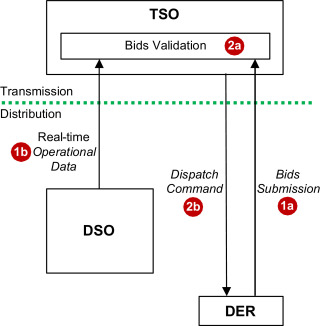
TSO is responsible for the DER and TER dispatch (i.e., a fully centralised dispatch) while accounting for both transmission and distribution networks constraints.
- DER send their bids directly to the TSO for a given service period. The TSO also receives real-time operational data from the DSO.
- The TSO performs a centralised validation of DER services bids and computes the dispatch of TER and DER. The corresponding dispatch commands are sent to DER.
TSO-DSO Hybrid-Managed Model
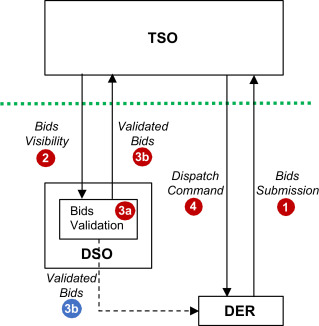
TSO is responsible for the DER and TER dispatch (i.e., a centralised dispatch), but it does not consider any distribution network aspect. The DSO is the entity responsible for validating DER services bids to guarantee network integrity.
- DER send their bids directly to the TSO for a given service period.
- The DSO is informed about the bids.
- The DSO performs the validation of DER services bids. Then, it transmits the validated bids and requests to the TSO and/or to DER.
- The TSO performs the dispatch and sends the dispatch command to DER.
DSO-Managed Model
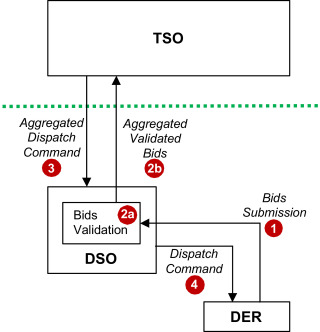
The core coordination process without the presence of distribution-level markets:
- DER send their bids to the DSO for a given service period.
- The DSO performs validation of DER services bids and aggregates them. Aggregated bids are submitted to the TSO.
- The TSO performs the dispatch and sends the aggregated dispatch command to the DSO.
- The DSO sends the dispatch command to DER to match the aggregated requirement.
- TSO-Managed Model: The TSO makes all decisions, DSO is a passive data provider and does not manage the traffic.
- Pros: efficiency, transparency
- Cons: computationally heavy, data communication, TSO may be lack of knowledge of local physics
- TSO-DSO Hybrid-Managed Model: The TSO manages the market and the bidding, but the DSO must pre-validate every bid to make sure it won’t break the local grid.
- Pros: safety, simplified computation, privacy
- Cons: inefficiency/delays, more complex processes, potential DSO conflict of interest
- DSO-Managed Model: The DSO “aggregates” everything under its jurisdiction and presents it to the TSO.
- Pros: reduced complexity for TSO, privacy
- Cons: DSO lacks know-how on markets, potential DSO conflict of interest
The “Wear and Tear” Incentive
Electrical infrastructure, specifically transformers and underground cables, has a lifespan determined by heat. Power flowing through a wire creates heat. When a DSO pushes a transformer to 98% of its capacity to allow an Aggregator to sell solar power to the TSO, that transformer runs very hot.
The Conflict: The DSO is often the one who has to pay for the new transformer. If the DSO manages the “market” (DSO-Managed Model), they have a secret incentive to say, “Sorry, the grid is full,” even if it technically has 10% more room. By being “conservative,” they save themselves millions in premature equipment replacement costs.
Operational Risk vs. Market Benefit
When a grid operates near its limit, the “buffer” for errors disappears:
- DSO Perspective: “If I allow this aggressive flexibility trading and a cloud suddenly passes over the solar farm, I might get a voltage spike that trips a breaker. Now I have to send a technician out on a Sunday and handle customer complaints.”
- TSO/Market Perspective: “We need that flexibility to keep the national frequency stable and the price of electricity low.”
The Conflict: The DSO bears 100% of the operational risk (blackouts, equipment failure) but only sees a fraction of the market benefit (lower electricity prices for the whole country). Therefore, their natural inclination is to be “Risk-Averse.”
- Introduce independent DSOs that exchange the states with DSOs/TSOs.
- Probabilistic modeling could potentially solve this by creating a “Transparent Limit”: calculate the available room in the grid that is based on math and probability rather than the DSO’s subjective (and biased) preference.
Solution Techniques
- Distributed Optimization. An originally large-scale problem is decoupled in smaller problems (named subproblems, which are neighbours). For a given decoupled point, original variables (e.g., voltage, power) are duplicated, one for each neighbouring subproblem. This allows each subproblem to perform “local” decisions but maintaining some communication between neighbouring subproblems. In the end, neighbouring subproblems must match their decoupled variables, which in reality represents the same variable.
- Hierarchical Optimization. An originally large-scale problem is divided in subproblems, which are organised in a hierarchical structure. Each subproblem performs local decisions and communicates them to the next hierarchical level.
- Centralized Optimization. The large-scale problem is solved as a single problem.
- The centralized optimization is usually used for TSO-managed models.
- MV distribution networks are usually modelled with single phase AC OPF while the transmission networks are modelled with DC OPF.
- Scalability: most of the proposed techniques were tested in relatively small networks (≤900 single-phase buses).
TSO–DSO Coordination for Flexibility Management Across Voltage Levels
Introduction
Transmission and distribution networks were clearly delineated:
- TSO: ensure bulk power transfer, system-wide balancing, and frequency regulation across large geographic areas.
- DNO: as predominantly passive infrastructures, is responsible for delivering EL from transmission substations to end users according to deterministic planning and reliability criteria.
Under this, the T-D interface has limited interaction, high predictability of power flows, and a unidirectional exchange of EL. As a result, planning, security assessment, and Ancillary Services (ASs) procurement were executed almost exclusively at the transmission level, with distribution systems represented through aggregated and static equivalents.
While DNOs historically optimized local reliability and capital expenditure, DSOs are increasingly expected to perform system-level functions such as congestion management, voltage control, flexibility procurement, energy balancing, active network operation, and data orchestration.
Flexibility
Sources of Flexibility and Technical Constraints
This work understands flexibility as the ability of an asset (e.g. DER) to adjust its active or reactive power within its physical and operational limits, enabling it to respond to system needs and provide grid services.
- At the TN level, sources of flexibility: conventional and renewable generation units with fast ramping and regulation capabilities, FACTS, large-scale ESS and cross-boarder interconnections.
- In the DN: DGs, utility-scale and behind-the-meter BESS, flexible loads (HP, AC, water heater, EV…)
There are also non-power/energy related assets that can provide flexibility e.g. network topology, phase shifting, and on-load tap changing transformers, HVDC links.
Feasible Regions of Aggregated DN Flexibility at the Interface with the TN
The feasible region (PQ chart) characterizes the DER’s aggregated active/reactive power flexibility in the ADN that meets its operational constraints, which enables a coordination mechanism that preserves confidentiality while ensuring technical feasibility.
The feasible region under the full AC PF may be non-convex, discontinuous, including exhibiting holes …
Cost of Flexibility of Aggregated DN Flexibility at the interface with the TN
The mapping between the feasible region and the cost is needed for the computation of the TSO. Methods: brute-force (not scalable), sub-optimal methods…
Aggregation and Control of DERs for Grid ASs
Aggregation and control of DERs:
- Voltage support
- Frequency regulation
- use DERs aggregations [8], [9], [10], [11] or large populations of DERs [12], [13]
- challenges:
- Communication: processing massive amounts of real-time data from thousands of devices.
- Reliability: managing the uncertain availability and duration of DER flexibility.
- Coordination: resolving conflicting requests between TSOs and DSOs. Conflicting requests between SOs will require coordination or the definition of priorities [14].
- Local integrity: ensuring TN support doesn’t cause local overloading or phase imbalance.
Dynamic Equivalents of ADNs
gray and black box models, skip
T&D Simulation Tools
Mechanisms
TSO-DSO Coordination in Network Expansion Planning
FlexPlan: large scale, scenarios, decompose TN and DN, linear DN model. [15]
Challenges:
- probabilistic OPF
- large networks: Benders decomposition
- finding a linear yet accurate (equivalent) model of a DN
TSO-DSO Coordination for Power System Operation
Two mechanisms:
- Group A: look at TSO and DSOs control areas as an entire system and minimize its overall operation cost i.e., summing up the cost of TSO and DSOs [16], [17], [18], [19], [20]. However:
- TSOs and DSOs have their own specific goals, limited to their control area, and compete for utilizing DERs’ flexibility to minimize their cost
- to preserve data privacy and sensitive information, TSOs and DSOs cannot always share their cost or grid models
- TSOs and DSOs have a mandate and a duty to operate their grids safely, which they cannot readily pass along to a coordinating third party agent.
- Group B: recognize the peculiarities and data privacy of TSOs and DSOs and treat them as autonomous and competing entities in optimizing their objectives [21], [22], [23], [24]. However, the groupe B is computationally heavy in general.
Solution approaches: decomposition methods e.g. hierarchical, Benders’ decomposition, surrogate Lagrange relaxation, alternating direction method of multipliers
Distributed optimization naturally aligns with the decoupled physical structure of TSO-DSO systems, while the multi-period settings and time-coupling terms complicate the flexibility cost curves.
How to balance between the accuracy, tractability and the cost of aggregated flexibility of ADNs
The market-based procurement of flexibility
TSO-DSO Coordinated Flexibility Market Models
The integration of diverse flexibility sources requires structured cooperation to achieve two primary goals:
Process efficiency & value-stacking: streamlining the pre-qualification, procurement, and activation of flexibility. This allows a single “volume” of flexibility to serve multiple system operators simultaneously, maximizing its economic and operational value.
Grid safety & operational security: ensuring that when one operator activates flexibility (even from a source outside its direct control), it does not compromise the stability or safety of the connected grids.
Projects: SmartNet, CoordiNet, OneNet.
- Disjoint markets: a transmission-level disjoint market and a distribution-level disjoint market, in which each SO procures flexibility to resolve its own needs and without any access to flexibility from grids outside their area of control. [25], [26], [27], [28]
- Common markets: TSOs and DSOs jointly procure flexibility (in a co-optimized manner) to collectively resolve their needs from a common pool of flexibility resources (originating from the different grids) while abiding by the constraints of all the grids involved.[26], [27]
- Multi-level markets:a sequential, two-stage structure. In Layer 1, each DSO procures flexibility from Flexibility Service Providers (FSPs) connected to its distribution grid, subject to local operational constraints. In Layer 2, the TSO procures flexibility to address transmission-level needs, using both transmission-connected resources and the unused portions of bids forwarded from Layer 1.
- Direct flexibility sharing: a SO procures flexibility from resources located outside its grid.
- Indirect flexibility sharing: SO actions in its own grid create system needs resolved in a subsequent market.
- Fragmented markets: Layer 1 mirrors the first layer of the multilevel market: each DSO operates an independent market to procure flexibility from resources connected to its own grid, subject to local constraints.
- Multi-level markets:a sequential, two-stage structure. In Layer 1, each DSO procures flexibility from Flexibility Service Providers (FSPs) connected to its distribution grid, subject to local operational constraints. In Layer 2, the TSO procures flexibility to address transmission-level needs, using both transmission-connected resources and the unused portions of bids forwarded from Layer 1.
Market Model Efficiency Comparison
Stable TSO-DSO Cooperation and Cost Allocation
Network Constraints Considerations
FSP Strategic Bidding
TSO-DSO coordination to acquire services from distribution grids: Simulations, cost-benefit analysis and regulatory conclusions from the SmartNet project
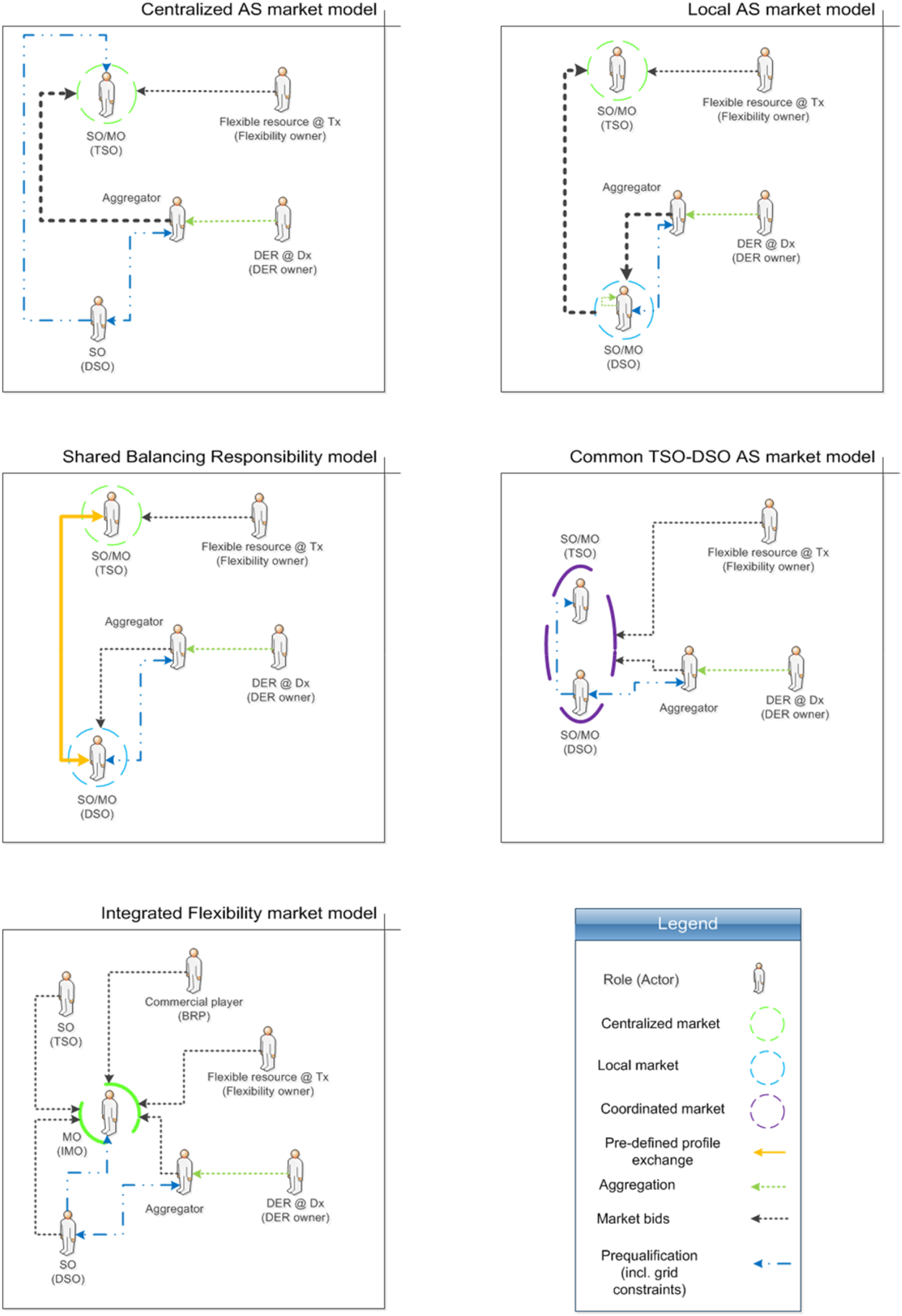
TSO-DSO coordination schemes
| Name | Scheme | Market Processing |
|---|---|---|
| Centralized ancillary services market model | The DSO is not involved in procurement of flexibility, with distribution market products only being purchased by the TSO for balancing and congestion management at transmission level | Bids are collected by aggregating resources with the granularity of transmission network nodes. Only system imbalance and transmission network congestions are solved by the market clearing routine. |
| Local ancillary services market model | Two-step procedure, where DSO has priority to buy flexibility for the management of distribution grid services (congestion management). The remaining flexibility (including the un-activated distribution one) can be procured by the TSO through a separate market aimed at activating balancing and congestion management services for the transmission network. | Bids are collected by aggregating resources with the granularity of distribution network nodes. First, distribution services (congestion management) are processed by local markets, while the non-selected bids are aggregated and forwarded to the central market aimed at solving system imbalance and transmission network congestions. |
| Shared balancing responsibility model | DSO and TSO manage their system separately, both performing balancing and congestion management. The distribution balancing service is operated by scheduling the power exchange between transmission and distribution network (power profile that is agreed between the two network operators). | Distribution and transmission networks are managed separately as independent systems. Bids collected at low/medium voltage levels are processed in order to solve only distribution network imbalance and congestions. Bids collected at high voltage levels are processed to solve only transmission network imbalance and congestions. |
| Common TSO-DSO ancillary service market model | DSO and TSO access the same market to buy flexibility aimed at solving congestions and balancing. As CS B, the DSO is responsible for the congestion management only at distribution level, and the TSO uses the same market to procure services it needs. | Bids are collected by aggregating resources with the granularity of distribution network nodes. Both distribution and transmission services are processed simultaneously by the same market clearing routine. |
[17] proposed a decentralized OPF algorithm using Analytical Target Cascading (ATC) and Diagonal Quadratic Approximation (DQA) to enable parallel, privacy-preserving coordination between TSOs and DSOs without the need for a central coordinator.
[29] developed a three-level hierarchical economic dispatch (HED) mechanism that utilizes Benders cuts to create Generalized Bid Functions (GBFs), enabling the calculation of Distribution Locational Marginal Prices (DLMPs) through an ACOPF SOCP relaxation.
[28] introduced a common transmission-distribution systems flexibility market model, in which SOs jointly procure flexibility from different systems to meet their needs. The common market is then formulated as a cooperative game aiming at identifying a stable and efficient split of costs of the jointly procured flexibility among the participating SOs to incentivize their cooperation. Several cost allocation mechanisms are then introduced for the common market.
[30] proposed a market-clearing model is proposed to facilitate energy and flexibility transactions through coordinating the flexibility providers in both transmission and distribution networks.
[21] developed a generalized Nash game (GNG) model and an improved iterative successive-intersection method to find equilibrium points where TSOs and DSOs optimize their own non-cooperative objectives, further refined by a Pareto-optimization step to recover system-wide efficiency.
[31] proposed a hierarchical electricity and carbon market under TSO-DSO coordination, established an electricity market which combines locational marginal price (LMP) and peer-to-peer (P2P) trading considering transmission and distribution coordination. A hierarchical distributed algorithm is developed to clear the market.
- TSO acts as the primary manager, uses OPF to set nodal prices while ensuring grid security and maximizing social welfare.
- DSO acts as intermediaries that pass electricity and carbon signals from the TSO while maintaining local grid security. MLMF Stackelberg game model is utilized to maximize each prosumer’s payoffs under electricity and carbon P2P trading.
[19] developed a look-ahead multi-interval (LA-MI) coordination framework using a bilevel decomposition with a novel Benders cut calculation method to compare statistically anticipated DSO actions (Exogenous) against a fully integrated organizational setup (Embedded).
[32] compared the flexibility aggregation via approximate dynamic programming (ADP) and distributed optimization via ADMM, observed that:
- the flexibility aggregation achieves near-optimal solutions with minimal communication while the performance depends on the quality of the approximation used.
- ADMM attains results closer to the centralized solution but requires significantly more communication steps.
[33] proposed a centralized common TSO-DSO market where both operators procure DER flexibility simultaneously. The cost is allocated based on the specific needs:
TSO objective: global balancing (keeping the whole grid stable).
DSO objective: congestion management and reactive power provisions (keeping the local lines safe).
It is observed that while the total cost of keeping the grid flexible stays relatively stable, the distribution of those costs changes significantly:
- Actions taken by the TSO for the whole grid might force the DSO to pay more to manage local effects, and vice versa.
- The DSO often ends up paying a larger share of the costs. This happens because DERs must adjust \(P\) to maintain specific power factors.
- When a DER is forced to adjust its output to help the DSO manage local congestion, it creates an “opportunity cost” that the DSO must shoulder.
[34] developed a bilevel coordination model that captures the hierarchical interaction between the transmission and distribution layers under a DSO-led configuration.
[35] developed a bi‐level optimisation framework for TSO-DSO coordination under wind power uncertainty. At the upper level, the TSO minimises system-wide generation costs while managing wind forecast errors through chance constraints. At the lower level, the DSO responds to locational marginal price and nodal carbon intensity signals issued by the TSO and minimises total operational costs, including electricity procurement, local generation and carbon costs. The carbon intensity at each transmission node is also reported by incorporating the carbon flow.