Learning Notes: TSO-DSO Coordination

Background, Policy, and Conceptualization
The increase of DER offers opportunities for system operators to make use of flexibility available in the distribution grid. Flexibility at the distribution level is now a strategic asset for frequency regulation, congestion management, and voltage control. Effective TSO-DSO coordination is the prerequisite for unlocking this potential without compromising grid integrity [1].
According to [2], the primary drivers for this coordination include:
- System security & stability: maintaining operational limits across the entire voltage hierarchy.
- Economic efficiency: reducing overall system costs.
- RES integration: increasing the hosting capacity for RES by actively managing local constraints.
The T-D coordination problem can be generally expressed as a multi-layer optimization framework involving both TSO and multiple DSOs. Its compact form can be written as [2]: \[ \def\eqcellsep{&}\begin{array}{@{}*{1}{l}@{}} {\mathop {\min }\limits_{{{{\mathbf{x}}}_{\mathbf {T}}},{{{\mathbf{x}}}_{\mathbf {D}}}} \quad {{C}_{T}}({{{\mathbf{x}}}_{\mathbf {T}}}) + \sum\limits_{i \in D} {{{C}_{D,i}}({{{\mathbf{x}}}_{{\mathbf{D,i}}}})} }\\ {{\mathrm{s}}.{\mathrm{t}}.\quad {{f}_{T}}({{{\mathbf{x}}}_{\mathbf{T}}}) = 0,\quad {{g}_{T}}({{{\mathbf{x}}}_{\mathbf{T}}}) \le 0,}\\ {\quad \quad {{f}_{D,i}}({{{\mathbf{x}}}_{{\mathbf{D,i}}}}) = 0,\quad {{g}_{D,i}}({{{\mathbf{x}}}_{{\mathbf{D,i}}}}) \le 0,\quad \forall i \in D,}\\ {\quad \quad {{h}_i}({{{\mathbf{x}}}_{\mathbf{T}}},{{{\mathbf{x}}}_{{\mathbf{D,i}}}}) = 0,\quad \forall i \in D,} \end{array} \] where:
- \(\mathbf{x}_{\mathbf {T}}\) and \(\mathbf{x}_{\mathbf {D, i}}\) denote the decision variables of the TSO and the ith DSO respectively,
- \({C}_{(\cdot)}\) represent their corresponding operating costs.
[3], [4] highlight distinct regional strategies for integrating DERs into electricity markets:
- In Europe, regulatory frameworks and flexibility markets aim to enable DER integration and frame the distribution-connected resources as esssential contributors to system-wide services and calls for revised operational, market and data-handling arrangements between TSOs and DSOs.
- Australia’s rapid DER growth has led to innovative approaches for grid stability, emphasizing DER management through system services and demand response. The coordination is evolving through initiatives like the Open Energy Networks Project, focusing on integrating DERs into the National Electricity Market (NEM). The Australian Energy Market Operator (AEMO) works with DSOs to enable DER to provide services to both distribution and transmission systems, addressing challenges in real-time operational data exchange and system stability.
- In ths US, distribution utilities largely remain vertically integrated monopolies regulated at the state level while bulk power system operation is performed by ISOs. It is developing models to address regional challenges in DER aggregation and market participation, with a focus on operational integration. For example, the FERC Order No. 2222 mandated that DER aggregations be permitted to participate directly in wholesale markets [5].
Market Design and Schemes
Coordination Schemes
[6] clustered the TSO-DSO coordination models into 3 categories:
- TSO-Managed Model: TSO is responsible for the DER and TER dispatch (i.e., a fully centralised dispatch) while accounting for both transmission and distribution networks constraints.
- TSO-DSO Hybrid-Managed Model: TSO is responsible for the DER and TER dispatch (i.e., a centralised dispatch), but it does not consider any distribution network aspect. The DSO is the entity responsible for validating DER services bids to guarantee network integrity.
- DSO-Managed Model: An aggregated dispatch command is sent by the TSO to the DSO who then dispatches individual DER to match the requirement.
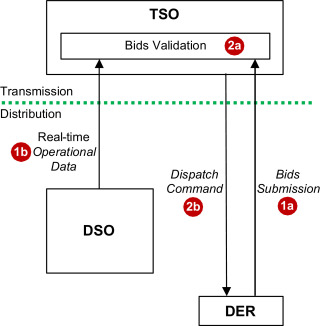
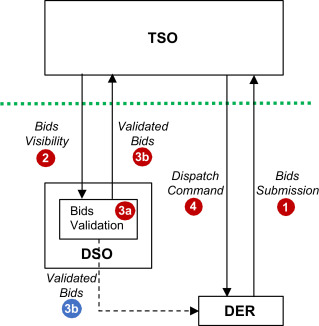
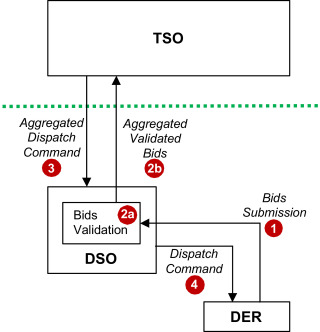
- TSO-Managed Model: The TSO makes all decisions, DSO is a passive data provider and does not manage the traffic.
- Pros: efficiency, transparency
- Cons: computationally heavy, data communication, TSO may be lack of knowledge of local physics
- TSO-DSO Hybrid-Managed Model: The TSO manages the market and the bidding, but the DSO must pre-validate every bid to make sure it won’t break the local grid.
- Pros: safety, simplified computation, privacy
- Cons: inefficiency/delays, more complex processes, potential DSO conflict of interest
- DSO-Managed Model: The DSO “aggregates” everything under its jurisdiction and presents it to the TSO.
- Pros: reduced complexity for TSO, privacy
- Cons: DSO lacks know-how on markets, potential DSO conflict of interest
| Name | Scheme | Market Processing |
|---|---|---|
| Centralized ancillary services market model | The DSO is not involved in procurement of flexibility, with distribution market products only being purchased by the TSO for balancing and congestion management at transmission level | Bids are collected by aggregating resources with the granularity of transmission network nodes. Only system imbalance and transmission network congestions are solved by the market clearing routine. |
| Local ancillary services market model | Two-step procedure, where DSO has priority to buy flexibility for the management of distribution grid services (congestion management). The remaining flexibility (including the un-activated distribution one) can be procured by the TSO through a separate market aimed at activating balancing and congestion management services for the transmission network. | Bids are collected by aggregating resources with the granularity of distribution network nodes. First, distribution services (congestion management) are processed by local markets, while the non-selected bids are aggregated and forwarded to the central market aimed at solving system imbalance and transmission network congestions. |
| Shared balancing responsibility model | DSO and TSO manage their system separately, both performing balancing and congestion management. The distribution balancing service is operated by scheduling the power exchange between transmission and distribution network (power profile that is agreed between the two network operators). | Distribution and transmission networks are managed separately as independent systems. Bids collected at low/medium voltage levels are processed in order to solve only distribution network imbalance and congestions. Bids collected at high voltage levels are processed to solve only transmission network imbalance and congestions. |
| Common TSO-DSO ancillary service market model | DSO and TSO access the same market to buy flexibility aimed at solving congestions and balancing. As the local ancillary services market model, the DSO is responsible for the congestion management only at distribution level, and the TSO uses the same market to procure services it needs. | Bids are collected by aggregating resources with the granularity of distribution network nodes. Both distribution and transmission services are processed simultaneously by the same market clearing routine. |
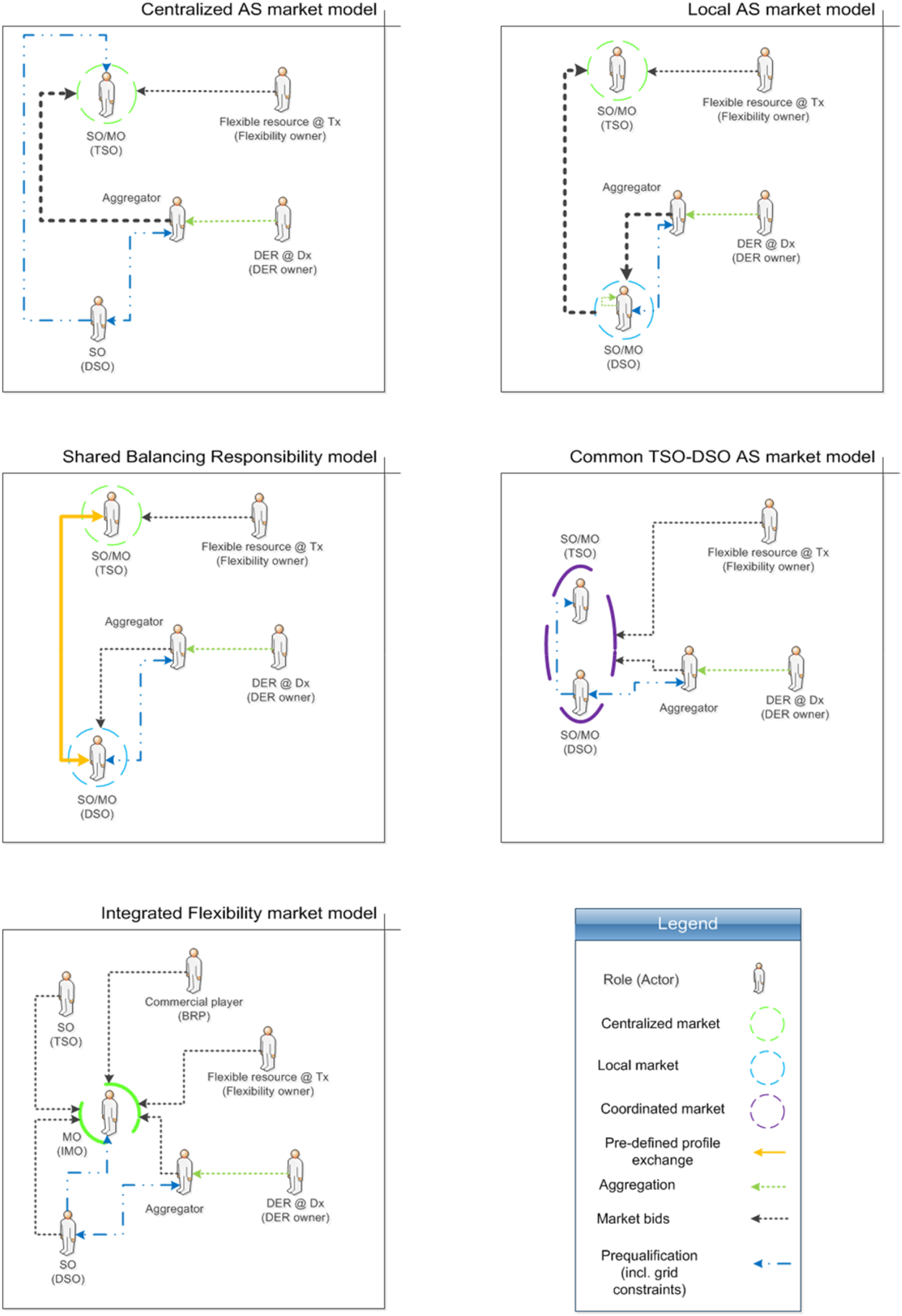
Based on [8], the different schemes offer different trade-offs:
- The Centralized Common Market model sets the first-best standard in terms of allocative efficiency, however it is challenging to implement due to the large scale of the optimization problem and the communication requirements.
- The Decentralized Common Market model strikes a balance between efficiency and computational / communication tractability. This is achieved by exploiting the fact that the TSO and DSO need only agree on the amount of real power flowing over the T-D interface.
- The Local Ancillary Services model is dominated by the Centralized Ancillary Services model in terms of allocative efficiency.
- The Shared Balancing Responsibility model will not violate physical constraints, however it appears to be the least efficient solution.
[9] formulated the coordination schemes as mathematical programs:
- Centralized co-optimization: Standard optimization; highest efficiency.
- Shared balancing responsibility: Non-cooperative game; slightly less efficient than centralized.
- Rational expectation from the DSOs: a multi-leader Stackelberg game and further a bilevel mathematical optimization problem.
and gave the key observations:
- The decentralized coordination schemes are more profitable for the TSO and that rational expectations from the DSOs gives rise to a last-mover advantage for the TSO.
- Highest efficiency level is reached by the centralized co-optimization, followed very closely by the shared balancing responsibility.
- The mean social welfare is higher for the Stackelberg game than under shared balancing responsibility.
Solution Techniques
- Distributed Optimization: Decouples a large problem into smaller, neighboring subproblems. Variables (voltage, power) are duplicated at the “split” point. Neighbors communicate to ensure these duplicated variables eventually match.
- Hierarchical Optimization: Organizes subproblems into a vertical structure (e.g., TSO on top, DSOs below). Lower levels solve local problems and send results up the chain.
- Centralized Optimization: Solves the entire T-D network as a single, massive mathematical problem.
- The centralized optimization is usually used for TSO-managed models.
- MV distribution networks are usually modelled with single phase AC OPF while the transmission networks are modelled with DC OPF.
- Scalability: most of the proposed techniques were tested in relatively small networks (≤900 single-phase buses).
Literature Examples
| Ref. | Optimization model-TSO | Optimization model-DSO | Temporal scope | Uncertainty | Market-framework | DER management |
|---|---|---|---|---|---|---|
| [9] | DCOPF | ACOPF | snapshot | TSO-DSO hybrid | ||
| [10] | DCOPF | ACOPF | multiple | hierarchical | TSO-DSO hybrid | |
| [11] | ACOPF | ACOPF | snapshot | centralized | TSO | |
| [11] | ACOPF | ACOPF | snapshot | decentralized | DSO | |
| [12] | ACOPF | ACOPF | snapshot | decentralized | DSO | |
| [13] | DCOPF | ACOPF | multiple | hierarchical | TSO-DSO hybrid | |
| [14] | DCOPF | ACOPF | snapshot | hierarchical | TSO-DSO hybrid | |
| [15] | SOCP | SOCP | snapshot | centralized | TSO | |
| [16] | DCOPF | DistFlow | multiple | hierarchical | DSO | |
| [17] | DCOPF | SOCP | multiple | hierarchical | TSO-DSO hybrid | |
| [18] | ACOPF | ACOPF | snapshot | decentralized | ||
| [19] | DCOPF | ACOPF | snapshot | hierarchical | TSO-DSO hybrid | |
| [20] | DCOPF | linear | snapshot | hierarchical | ||
| [21] | DCOPF | LinDistFlow | snapshot | decentralized | TSO-DSO hybrid | |
| [22] | SOCP | SOCP | multiple | decentralized | DSO |
Decentralized & Hierarchical Approaches
[14]: Uses analytical target cascading (ATC) and diagonal quadratic approximation (DQA) to allow TSOs and DSOs to coordinate in parallel without a central coordinator, preserving data privacy.
[23]: Compares ADP (flexibility aggregation) vs. ADMM (distributed optimization).
ADP: Near-optimal, low communication, but accuracy depends on the approximation.
ADMM: Closer to centralized optimal, but requires much more communication.
[15]: A three-level dispatch using Benders cuts to create bid functions, allowing the calculation of DLMPs via SOCP relaxation.
[20]: Uses a Look-Ahead Multi-Interval (LA-MI) framework to compare “Exogenous” DSO actions (statistical anticipation) against “Embedded” (fully integrated) setups.
[16]: Focuses specifically on a DSO-led configuration using bilevel optimization.
[19]: A bilevel framework addressing wind uncertainty. TSO minimizes costs/forecast errors (top), while DSO responds to price and carbon signals (bottom). The carbon intensity at each transmission node is also reported by incorporating the carbon flow theory.
Game Theory
[24]: Frames a common flexibility market as a Cooperative Game. Focuses on how to split costs fairly to keep all operators incentivized to cooperate.
[17]: Proposes a joint market-clearing model for energy and flexibility across both network levels.
[18]: Uses a Generalized Nash Game (GNG) where TSO and DSO are non-cooperative, then uses a Pareto-optimization step to recover system efficiency.
[10]: Combines LMP and P2P trading. In this model, the TSO manages the big picture (welfare/prices), while the DSO acts as an intermediary for prosumers in a Stackelberg game.
Cost & Operational Impact
[13] proposed a centralized common TSO-DSO market where both operators procure DER flexibility simultaneously. The cost is allocated based on the specific needs:
TSO objective: global balancing (keeping the whole grid stable).
DSO objective: congestion management and reactive power provisions (keeping the local lines safe).
It is observed that while the total cost of keeping the grid flexible stays relatively stable, the distribution of those costs changes significantly.
- Learn more about the market clearance and game theory
- Learn more about the distributed optimization algorithms
Applications
Network Expansion Planning
Future network expansion planning need to take the flexibility-based alternatives into consideration instead of only the option of building new physical assets. The FlexPlan project [25] serves as a case study for this transition in Europe.
[26] introduced a transmission-aware distribution network planning (TADNP) method, which is based on netload range cost curves (NRCCs), an approach for managing long-term DER growth uncertainty through T&D coordination. NRCCs provide:
- peak substation netload guarantees: define the maximum and minimum netload range the substation will experience
- corresponding distribution upgrade options and costs
Iteration procedure:
- Deterministic least-cost model: The DSO first solves a LCDNP using only a single nominal scenario which establishes the expected netload range as a baseline without considering uncertainty.
- Scenario-based least-cost model: The DSO solves the LCDNP model across multiple future scenarios of DER growth and identifies the least-cost feasible budget.
- NRCC calculation: The DSO uses a transmission-aware distribution network planning (TADNP) model to iteratively increase the investment budget by an increment. and for each budget, optimizes the assets (BESS) to narrow the peak netload range as much as possible. → NRCC (cost vs. netload range)
- NRCC-informed transmission planning: The TSO integrates the DSO’s NRCC and makes its own transmission planning.
- Model the coordinated planning instead of the integrated planning as the operators remain autonomous, exchanging data only at border nodes.
- Introduce probabilistic OPF to handle the uncertainties.
- Need to improve for large networks with thousands of DSOs, e.g. use composition algorithms
- Find a linear yet accurate enough model of DNs
Operational Scheduling
[27] proposed a risk-averse stochastic MILP model for an aggregator to optimize bids for a joint fleet of EVs and BESSs in DA and AS markets while the DCOPF is used.
[28] developed a deterministic TSO-DSO operational scheduling coordination problem and a decomposition approach by updating Lagrangian multipliers. The nonlinearities at the TSO level caused by AC power flow constraints are resolved through a dynamic linearization while guaranteeing feasibility through “l1−proximal” terms.
[29] used bi-level programming to construct a robust unit commitment (UC)-based coordination (RUCC) methodology for collaborative TSO-DSO generation scheduling. The first and second layers consider the TSO and DSOs’ scheduling problems, where adaptive robust optimization (ARO) tackles the uncertainties at both levels. The bilevel problem is solved using an iterative approach, while the TSO/DSO scheduling problems are solved using the column-and-constraint generation (CCG) technique.
[30] proposed a model for DER participation in TSO-DSO coordinated operation based on dynamic topology adjustment of DN, enabling DSOs to dynamically optimize DN topology and DER output based on TSO dispatch instructions. A two-stage deep reinforcement learning algorithm (TSDRL) is developed to optimize network topology and DER output, overcoming challenges in large-scale topology optimization and non-convex problem handling.
[22] proposed a two-stage flexibility provision framework in coupled power-transportation network considering that DSOs can provide services to TSOs. An adaptive ADMM algorithm is adopted for distributed optimizations.
[31] proposed a two-stage stochastic coordination framework that explicitly models TSO–DSO interactions within coupled energy and reactive power markets. In the first stage, DSOs determine their optimal bidding strategies, which include energy and reactive power demands submitted to the wholesale market. In the second stage, the TSO schedules operations based on the aggregated bids received from the DSOs. The overarching objective is the minimization of total operational costs across the coordinated TSO-DSO system, subject to technical and operational constraints.
- Accuracy: very few works covered the stochasticity, multi-periods, and N-1 security at the same time.
- Scalability: computation bottleneck of non-linear problems.
- Very few paper considered/applied the cost curve (flexibility cost map) of the interface in the coordination framework.
Ancillary Service
Congestion Management
[24] examined the performance trade-offs between an introduced linear flexibility market model for congestion management and a benchmark SOCP formulation. The linear market model incorporates voltage magnitudes and reactive powers, while providing a simpler formulation than the SOCP model, which enables its practical implementation. It is shown that with the increasing spread of offered flexibility throughout the system, the linear formulation increasingly preserves the reliability of the computed system variables as compared to the SOCP formulation, while more lenient imposed voltage limits can improve the approximation of prices and power flows at the expense of a less accurate computation of voltage magnitudes.
[32] proposed a method that can embed the congestion limits to the DSO feasibility set, which can effectively release the computational costs.
- Initialize with current operating point, loading level, renewable penetration level, DERs injection values at last dispatch , PCC voltage and power transfer.
- Check the voltage and thermal limits; construct the solvability region.
- Following the increasing/decreasing direction of DERs’ power injection, compute next operating point.
- Check operational constraints and congestion limits.
- If no violation, move to the compute the next operating point, reconstruct the solvability region, repeat 3.-5.; if violated, return previous set and operating point.
[33] decomposed the overall AS problem into two sequential stages: (i) active power related i.e., for congestion management, and (ii) reactive power related AS (i.e., for voltage support). The proposed approach considers real-world challenging aspects such as the N-1 security at TSO level and operation uncertainties at both TSO and DSO levels. Accordingly, the approach relies on tailored versions of stochastic multi-period AC security-constrained optimal power flow (S-MP-SCOPF) at TSO level and stochastic multi-period AC optimal power flow (S-MP-OPF) at DSO level.
Voltage Support
[34] demonstrated how small-scale PV systems can provide reactive power services to other networks by means of their local controllers that change their logic to respond to external requests. The paper focuses on the voltage support concept for the Swiss transmission system. The coordination defines when DERs must participate in voltage support, which task to perform and how to fulfill it. It is demonstrated that dispersed units can engage in system objectives, and still be able to support local voltages when required.
In Switzerland, a DSO whose network is directly connected to the transmission system can choose between passive or active participation in voltage support [34]:
- In the passive role, the DS is economically encouraged to limit the reactive energy exchange EQ , measured every 15 minutes , to the symmetrical cost-free region.
- In the active role, the DS is obliged to use its freely available reactive power to support the TN voltage when requested by the TSO, without compromising the active power.
[35] proposed a centralized tractable OPF-based control scheme that optimizes the real-time operation of active DNs, while also considering the provision of voltage support as an ancillary service to the TN for the Swiss case. The potential benefit of AS provision assuming different operational modes of the DER inverters are investigated.
[36] presented a method to exploit consumers’ flexibility for the provision of AS. The proposed framework offers a control-based approach that adopts price signals as the economic driver to modulate consumers’ response. In the framework, various system operators broadcast price signals independently to fulfil their AS requirements. Appropriate flexibility estimators are developed from the TSO and DSO perspectives for price generation. An ANN controller is used for the TSO to infer the price-consumption reaction from pools of consumers in its territory. A PI controller is preferred to represent the consumers’ price-response and generate time-varying electricity prices at the DSO level for voltage management.
Given the high controlability of distributed generating units (DGUs), [37] proposed a method to support the TS during emergency situations. An adaptive voltage emergency control scheme based on the synchronization of DGUs and the load tap changer of the corresponding distribution transformer introduces a new adaptive and non-intrusive voltage emergency control scheme based on the synchronization of DGUs and the load tap changer of the corresponding distribution transformer.
[38] demonstrated how ADNs can be used in an optimal manner in order to support longterm voltage stability in a power system, which is based on a two-stage optimization including a central controller and a number of ADNs.
[33] decomposed the overall AS problem into two sequential stages: (i) active power related i.e., for congestion management, and (ii) reactive power related AS (i.e., for voltage support). The proposed approach considers real-world challenging aspects such as the N-1 security at TSO level and operation uncertainties at both TSO and DSO levels. Accordingly, the approach relies on tailored versions of stochastic multi-period AC security-constrained optimal power flow (S-MP-SCOPF) at TSO level and stochastic multi-period AC optimal power flow (S-MP-OPF) at DSO level.
Frequency Regulation
[39] proposed an aggregator that makes efficient use of the distributed power of EVs to produce the desired grid-scale power for frequency regulation.
[40] and [41] developed and experimentally demonstrated a hierarchical control scheme for optimally dispatching thousands of deferrable loads and DERs across a distribution feeder to provide FFR within 500ms.
[42] dealt with the provision of primary frequency response (PFR) from ADNs to the TS. Two methodologies are proposed. The first one targets to quantify the PFR capability range of ADNs. This range is determined by computing the range of the aggregated P(f) droop curves at the POI with the TS. The second methodology aims to optimally dispatch DERs to guarantee specific frequency regulation characteristics at the POI with the TS. This frequency regulation characteristic is expressed by means of a P(f) droop curve. The dispatch of the DERs is performed in an optimal way targeting to minimize a DSO-defined cost function. This cost function aims to minimize either total system losses or de-loading of DERs.
[43] bridged the gap between economic studies of the aggregator’s frequency containment reserve market participation and the distributed energy resources’ dynamic response. MILP is used for the aggregator’s portfolio management that incorporates constraints of individual units’ fast dynamics. The results demonstrate the importance of including reserve activation constraints when modelling storage technologies and settling time constraints when modelling conventional units.
[44] argued that utilizing numerous DERs for frequency regulation may jeopardize micro-level local voltage security within DNs. Thus a unified hierarchical framework based on the principle of synergistic co-design, which employs a stage-dependent architecture that systematically integrates distinct control strategies for different regulation stages is proposed. For security-critical response, it utilizes a novel stage-aware adaptive virtual synchronous generator (VSG) control method with stability formally proven by Lyapunov analysis, while for economic efficiency, it transitions to a distributed control method for cost-optimal restoration. It is demonstrated that the proposed approach enables scalable, secure, and economical frequency support while effectively managing the emergent voltage challenges from collective DER control.
- Future schemes must leverage DER participation optimally to avoid over- and under-responses, inefficiencies, and unnecessary DER saturation at their operational limits (active/reactive power, or state of charge), as DERs from one substation may be more suitable to participate than those from other substations. [4]
- Scalability: communicate with and control thousands of DERs in real-time.
- The uncertain availability of DERs when the service is needed.
- Multi-service provision: conflicting requests between SOs will require coordination or the definition of priorities.
- Local constraint violation: participation of DERs for TN support should not deteriorate the operation of the DN.
Flexibility Region
Aggregation
Work as the mathematical interface between TSOs and DSOs.
For the TSO: They receive the map and use it to solve their own national balancing problem. Instead of trying to model the DSO’s customers, they just see one VPP with a clear set of prices and physical limits.
For the DSO: It acts as a safety shield. Because the DSO calculated the map based on its own grid constraints, any point the TSO chooses from that map is guaranteed to be “safe” for the local network.
| Ref. | PF model | Solution method | Timescale | Uncertainty | Cost | Network size | Other features |
|---|---|---|---|---|---|---|---|
| [45] | ACOPF | Monte Carlo | snapshot | 210 | |||
| [46] | ACOPF | optimization | multiple | ellipsoid | |||
| [47] | ACOPF | optimization | snapshot | 9 | |||
| [48] | ACOPF | optimization | snapshot | 861 | |||
| [49] | linear OPF | optimization | snapshot | 130 | |||
| [50] | ACOPF | optimization | snapshot | 34 | |||
| [51] | ACOPF | optimization (convex approx) | multiple | 366 | ellipsoid | ||
| [52] | ACOPF | optimization | multiple | 123 | polygon | ||
| [53] | ACOPF | optimization | multiple | 93 | |||
| [54] | ACOPF | optimization | multiple | 30 | |||
| [55] | ACOPF | optimization | snapshot | 37 | |||
| [32] | ACOPF | optimization | multiple | 123 | |||
| [56] | linear | optimization | multiple | 34 | |||
| [57] | optimization | multiple | 141 | dynamic feasible region | |||
| [58] | ACOPF | optimization | multiple | 123 | polytope, bound shrinking | ||
| [59] | |||||||
| [60] | linear | optimization | multiple | 180 | DRO | ||
| [61] | ACOPF | optimization | multiple | 34 | P cost curve | ||
| [62] | ACOPF | optimization | multiple | 34 | Q cost curve | ||
| [63] | ACOPF | optimization | snapshot | 34 | decouple PQ cost curve | ||
| [64] | |||||||
| [65] | DistFlow | optimization | snapshot | 33 | game theory | ||
| [66] | LinDistFlow | optimization | snapshot | 123 | |||
| [67] | ACOPF | optimization | multiple | 33 | ellipsoid, multiple AS |
[45], the original paper, uses Monte Carlo simulation to estimate the flexibility range of \(P\) and \(Q\) at the boundary nodes between TSO and DSO.
[50], an ACOPF-based method to approximate PQ capability map by generating the piece-wise linear PQ charts (providing \(2M+4\) of the PQ points). The cost map is not considered.
[48], an ACOPF-based method to estimate the flexibility map: initiate → insert into consecutive → converge. Improves the computational efficiency. Limitations: the non-convexity is not considered, the temporal coupling is not considered.
[49], linearized [47], defined 5 types of flexibility providing units.
Challenges
Non convexity
[59] presented a simple counterexample demostrating that flexibility regions in radial grids can be non-convex, mainly due to the minimum voltage limits.
[47] discovered that when considering discrete variables, it is neither possible to guarantee that the flexibility domain remains convexly connected, nor to assure that it remains connected, as it may become composed of disjoint parts. An enumeration inspection may be required, but only valid within a reasonable limit.
[64] flexibility region can be discontinuous due to overvolatage constraints.
[55] flexibility region can include exhibiting holes.
Temporal coupling
How to integrate the time coupled flexibility devices such as ESS into the flexibility regions?
[51] the flexibility aggregation set obtained through a hyperbox approximation is very conservative and that a larger one can be obtained with an inner ellipsoidal approximation.
[52], an approximate method, decomposing the flexibility aggregation set in a virtual battery and virtual generator, considering the uncertainty through chance constraints assuming Gaussian probability distributions.
[53], a framework based on the concept of nodal operating envelope
[67], a multi-service flexibility aggregation approach based on ellipsoidal sets, considering the uncertainty via chance constraints
Cost curves
[63], a methodology to compute analytical functions approximating the cost curves of \(P\) and \(Q\) aggregated flexibility in the short-term operation of an ADN.
[33], [62] decoupled \(P\) and \(Q\) related services and proposed a method to calculate piece-wise linear cost curves of active power flexibility of an ADN in a multi-period timeframe.
[33], [61] decoupled \(P\) and \(Q\) related services and proposed a method to calculate piece-wise linear cost curves of reactive power flexibility of an ADN in a multi-period timeframe.
[65], a framework for tracing, ranking, and valuation of aggregated DER flexibility in ADNs. Showed that in the context of aggregated flexibility valuation, the Shapley value can be used as a mechanism that inherently includes availability and delivery (utilisation) payments for flexible units.
Uncertainties
[51], [52], [65], [67]few papers modelled the uncertainties when calculating the flexibility map.
Disaggregation
Once a TSO selects a \(P\)-\(Q\) point within the DSO’s reported flexibility region, the DSO must disaggregate that setpoint into specific commands for multiple DERs.
[68] introduced an scalable approach to quantitatively describe and price flexibility based on zonotopic sets. A subgradient-based disaggregation algorithm based on zonotopic sets has been presented that can be used to efficiently distribute aggregate-level signals in an economically optimal and fair way.
[69] proposed a genetic algorithm (GA) framework for multi-objective flexibility disaggregation to a set of distributed EMSs. The GA allows a posteriori selection of an optimal schedule from the Pareto-optimal solution set, which is beneficial if multiple different stakeholders are involved with unknown elasticity to their objective goals. The multi-objective GA fitness function considers:
- the resource aggregator, who wants to minimize the cost for flexibility while maximizing the probability of delivery;
- the grid operator, who wants to minimize grid losses;
- the resource provider (household owner), who wants to maximize level of self consumption;
- the fairness service provider, who wants to ensure that among EMSs a fair level of autarky and self-consumption is reached.
[70] proposed an algorithm to integrate stochastic flexibility calculus with the evolutionary algorithm to enable uncertainty of flexibility potentials. Uncertainty creates a trade-off between minimizing the risk of lacking flexibility potentials and avoiding wasting (demand-side) flexibility potentials. To address this trade-off during disaggregation, an indicator for assessing the probability of wasting flexibility potential is introduced as an extension of the stochastic flexibility calculus.
[71]: a Python package for flexibility aggregation and disaggregation with considering general storage devices and hierarchical aggregation settings.
[67] seems to be able to tackle a lot of challenges: stochasticity, time-coupling, scalability, multiple ASs, disaggregation
- Short-term
- Make a benchmark of the aggregation/disaggregation methods proposed in the literatures, compare the computation efficiency, area of the region, limitations, and think about possible updates.
- Implement and investigate the proposed coordination market schemes and corresponding solution techniques, compare the efficiency
- Next: A closed-loop framework that incorporates:
- T-D interaction: DSOs calculate and report FRs → TSO performs a system-wide OPF and picks a point → DSOs disaggregate and provide the flexibility services
- Uncertainty-aware probabilistic operation
- Scale: check large scale performance
- Privacy-aware solution techniques
- Time-coupling (and sector-coupling, or carbon-aware [10], [19]) operation